Hello @Animator
At the moment, there is an example of BP_Avatar_Mannequin
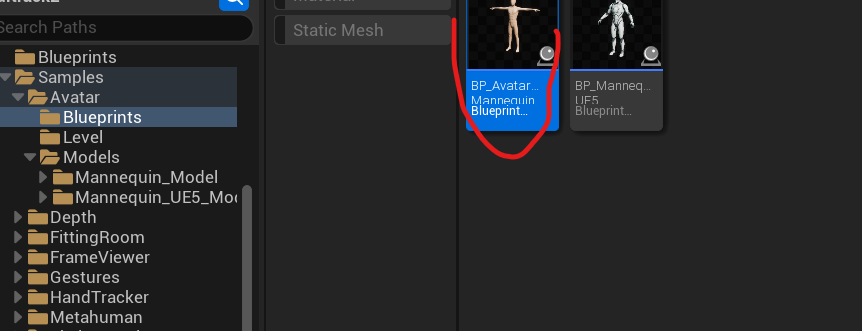
and such a text tutorial (it may be a little outdated and you will need to create a copy of the Mannequin instead of the child BP and edit it):
In general terms:
- in the blueprint, we get the positions and rotations of the bones, fill in the array, and pass it to Animation Blueprint (JointsTransform)
- In the Animation Blueprint, for each desired bone, we set the rotation (and position, if necessary) from this array. (the bones of the model are selected in the Transform (modify) Bone nodes, and you need to select the bones that are logically as close as possible to the tracked joints (point 3 in the tutorial))
- the “Start” variable is needed so that the Blueprint retains the default rotations of the bones (The model must be in the T-Pose while “Start” is set to “False”. If the model is in a different position, then you can set the rotations of the desired bones, for example, using Transform Bone in Animation Blueprint) of the model (from the Joints variable), after which the value of the variable changes to True and Nuitrack orientations are added to the standard rotations.
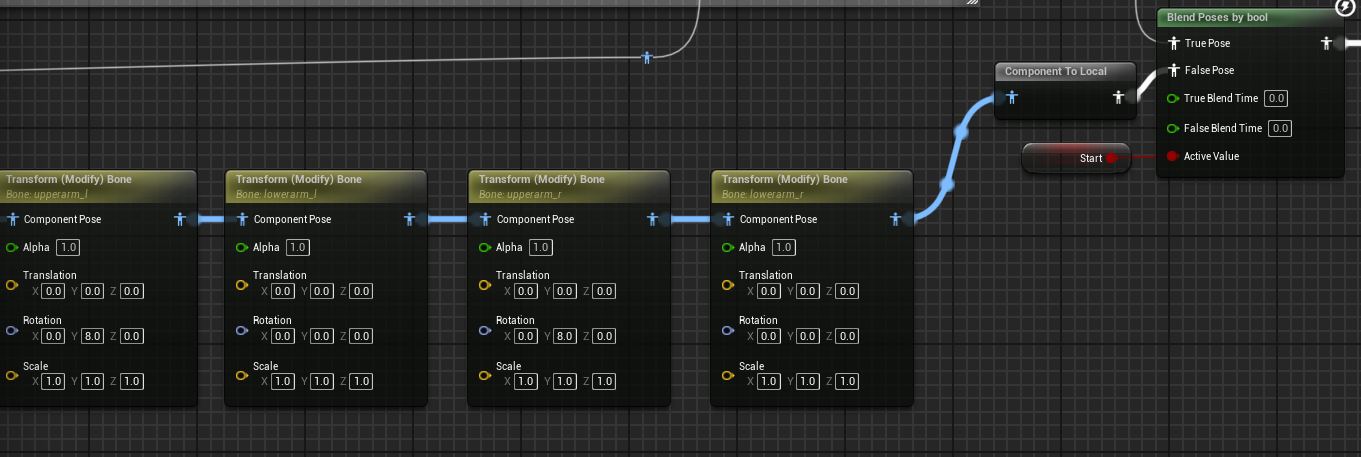
Force to T-Pose in ABP_Unreal_Default_Nuitrack
At the moment, everything about Metahuman is easier to set up because of the unified system, but in fact there are not many differences with any other human model (mainly the names of bones and their default orientation). It is better to focus on ABP_Unreal_Default_Nuitrack and BP_Metahuman_Nuitrack.
In general, for humanoid models, it is better to use the skeleton that is used in Metahuman (Epic Skeleton), it might be easier to make changes to the skeleton.